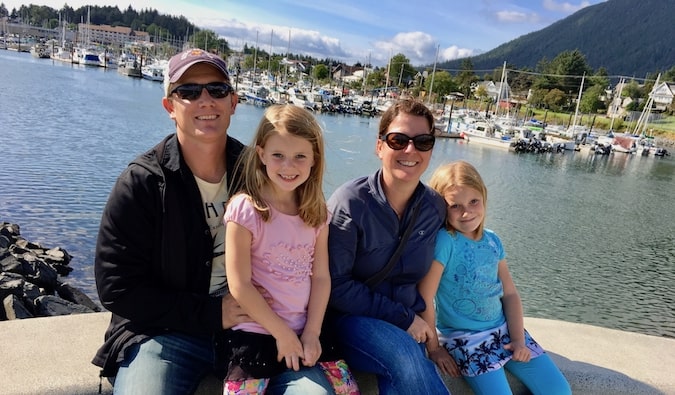
Have you ever desired to take your family on a global tour? Uncertain about how to achieve it on a tight budget? Uncertain about how to go with their education? Even though I am childless, I am constantly interested about how families accomplish these tasks.
I am currently having a conversation with Amanda, an Idaho resident and author of humorous travel and parenting tales. In this interview, Amanda discusses how she travels with her children for months on end, how she manages her finances, and how she keeps up her education while on the road!
Tell us a bit about yourself!
Although I write as AK Turner, my name is Amanda. I am a 40-year-old mother of two from Maryland who currently resides in Idaho. My spouse runs a real estate agency, I work full-time as a writer, and we travel abroad for roughly four months each year.
I was a starving artist for a good ten years before I started writing full-time. I cleaned houses and waited tables. I was astounded by how many people believe there is just one way to parent (typically their way) and overwhelmed with advice when I became a mother.
I channeled that energy into writing. The result was my first book series, a fairly foul-mouthed, parenting-humor trilogy: This Little Piggy Went to the Liquor Store, Mommy Had a Little Flask, and Hair of the Corn Dog. The books did well and eventually made the New York Times best-seller lists.
As our travel increased, I began writing the Vagabonding with Kids series, travel humor books that chronicle our adventures and mishaps along the way.
How did you get into traveling?
I visited Russia for the first time many years ago when I was fifteen years old as part of an exchange program. I lived with a host family and attended a Russian high school for four months in the Moscow suburb of Shchyolkovo. Since then, I have been infected with the travel bug.
Four years later, I returned to Moscow State University for a semester of college, this time sharing a dorm with a Korean roommate. She did not speak English, and I did not speak Korean, so we had to practice our Russian. She served me delicious kimchi as well.
What made you decide to travel with your kids so often?
It would have been simple to establish a pattern in one place after having children, but it did not feel right as a way of life. Not only do I enjoy traveling, but I also think that introducing my kids to different nations and cultures will be quite beneficial. It is impossible to measure the worth of that education.
They pick up skills like flexibility, thankfulness, empathy, languages, and cultural awareness. It is crucial, in my opinion, for kids to understand that there are a wide variety of lifestyles outside of their suburb.
Realizing how important it is to step outside of your comfort zone is another source of motivation. Please understand that I adore comfort. It sounds great to order takeaway and binge-watch Netflix! However, I believe that staying put and following the same schedule year after year leads to stagnation.
A diverse range of life events is very valuable to me and my family.
What’s been the biggest lesson so far?
The most important thing I have learnt is that there is no one correct method to travel the world. We become obsessed with demonstrating that we are “travelers” rather than “tourists,” as though the former designates us as genuine and successful while the latter labels us as displaced, unadventurous failures. It was liberating to let go of these lies.
I discovered that taking the trip and deviating from the usual route is acceptable. I am not trying to prove anything; our means and mode of transportation are whatever work for us at the moment. I do not have to eat goat brains just because Anthony Bourdain did in South Africa.
What advice do you have for people looking to travel with their children?
Compared to adults, children are frequently more adaptive. We often overlook this and think that if they do not have their regular routine and timetable, everything will fall apart. You might be surprised by them.
I know a lot of parents who are afraid to take their kids on lengthy international trips. In actuality, domestic flights are much more difficult than international ones. You are accommodated more on international flights, and every seat has a screen and an infinite selection of movies. Now that they know they get to enjoy movie marathons, our children love long trips. It turns out to be a delight for kids because we are not huge on screens and electronics.
I have seen a lot of parents who believe they are unable to take their children on vacation during the academic year. We homeschool now, whether we are in Idaho or overseas, but when we were in Boise for a few years, kids went to the public primary school.
I would frequently inform a teacher that we would be taking a few months off during parent-teacher conferences. There was not a single negative response from a teacher. They frequently provided us with resources to take with us and were quite supportive.
I think it’s important to know that not only can you buck convention and break the rules, but you also might be commended for it and helped along the way.
Traveling with kids seems costly. How do you keep your expenses down?
by utilizing miles and points! We use three distinct Alaska Airlines credit cards: one for personal needs, one for my business, and one for my husband’s business. We accrue miles every month since regular bills, such as phone bills and monthly subscription services linked to the businesses, are automatically charged to one of these credit cards.
Furthermore, every flight we take adds miles to our daughters’ individual mileage figures. Our only out-of-pocket expenses are taxes and incidental fees once we accrue miles and use them for travel. Our family of four recently paid somewhat more than $300 USD for round-trip tickets from Boise to Madrid during a six-week period.
We also use HomeExchange.com to trade homes with people around the globe. Leveraging our home in this manner allows us to eliminate the expense of hotels or long-term rentals. By having a house with a kitchen, as opposed to a hotel room, we save money by preparing our meals instead of eating out all the time.
If we’re unable to set up a home exchange, we’ll rent out our home on Vrbo.com. The income from two weeks of renting out our home covers our mortgage payment, plus approximately $600 USD. This overage can then be applied to accommodations in our destination country (in many cases a home or apartment booked through Airbnb — again, so that we can have a kitchen, prepare meals, and reduce the costs of eating out).
We frequently trade both houses and cars, which is an alternative that may be discussed on HomeExchange.com. We can travel for longer periods of time because the costs of lodging and in-country transportation are eliminated.
Vehicle exchanges are not always possible, of course. We needed to rent a car for two periods of time while in Australia. We found that there are alternatives to the standard automobile rental company after doing some internet research. We were able to hire cars for significantly less than what they would have otherwise cost thanks to DriveMyCar.com.au, which connects prospective renters with individuals who have extra wheels and the desire to make a little extra cash. By using DriveMyCar.com.au instead of a rental agency, we were able to save more than $300 USD on a month-long automobile rental.
Additionally, we view long-term travel as a normal part of life rather than a holiday. Instead of going on vacation, we travel to live in a different culture. In other words, we are searching for experiences rather than trinkets, upscale dining establishments, and tourist traps.
Our objective is to either spend the same amount or less than we would if we were residing in our Idaho house. Bring on the peanut butter and jelly sandwiches if that means we can spend a few weeks traveling the Australian coast in a camper van.
What’s been the biggest challenge traveling with your kids?
Adapting our children’s education to a more nomadic lifestyle can be a bit of a puzzle. We use an extensive mix of online education tools, including:
- IXL, a monthly subscription for access to K-12 lessons in math, social studies, science, and language arts
- Khan Academy for math tutorials, coding, and adult education
- Señor Jordan for basic Spanish
- Crash Course Kids for science lessons
- Duolingo for my own language learning
- Typing.com for keyboarding lessons
- Magic Treehouse for game-based learning
E-readers come in handy, as our daughters read chapter books at a pace that would prohibit carting along enough material to get them through a trip.
Given that laundry list, one might think our daughters are glued to screens when we travel, but just as much as we use computer-based learning, we also try to employ local culture. An educational assignment might include interviewing a local business owner about the three biggest challenges they face in their community, comparing flora and fauna to that in the US, or learning the meaning behind a country’s flag.
Though figuring out how to educate our children on the road has been a challenge, it’s been an enjoyable one.
What other challenges are there to consider?
As it is, kids are difficult. Being in a foreign place does not make it more harder for me. However, if there is a major language barrier, navigating foreign hospitals and emergency rooms can be challenging. For this reason, I always recommend having at least a basic understanding of the language of your host nation (it is also just the polite and acceptable thing to do). When you are not fluent in the language, patience and sign language can help.
In my family of four, time is the biggest obstacle. My spouse and I must find out efficient tag-team parenting that gives us the time we need to devote to our individual enterprises because we cannot afford to stop working when we travel. My spouse gets up early and starts working, which is the general framework we employ (although again, this is a flexible endeavor that adapts as needed). In the morning, I help the children with their schoolwork and breakfast.
Around lunchtime, my spouse takes over; by then, he has completed a full workday. I can write and focus on my business because of this. We are prepared to go out and explore by the middle of the afternoon.
Do you meet a lot of other families on the road? Are there any good resources or websites out there for families to connect?
We’ve met many traveling families: in campgrounds, hostels, and simply when exploring a new city. On a remote beach in Mexico we met a family from Virginia with similar plans and children of similar ages to ours. We met up with them a few times, connected on Facebook to stay in touch, and fostered an ongoing pen-pal relationship between our daughters.
Worldschoolers and Multicultural Kid Blogs are both excellent for connecting with other traveling families and discovering new resources for education, travel, and parenting abroad.
Why do you think few families travel like this? More and more seem to do so, but compared to solo travelers, traveling families aren’t as common.
Many parents worry about the risks their kids might encounter in a different nation or culture. In actuality, I believe my kids are safer when we travel because I am more vigilant and conscious of my surroundings. In order to successfully travel in strange territory, I pay closer attention.
People are sometimes held back by money because they believe that traveling entails costly flights and hotel accommodations, which is not always the case.
But basic custom is by far the biggest obstacle preventing families from progressing. Up until recently, our society pushed a monochromatic vision of what a family should be, which included remaining put during the school year and taking a two-week summer vacation. Examples of alternatives to this routine have emerged in the information age, and more families will take those first steps and take off as more good accounts of extended family travel are heard.
What have been some of your favorite experiences?
During the Christmas season, I had some of my most memorable encounters. We spent a year in a small Tasmanian village on the Tasman Peninsula. We visited the Port Arthur convict camp on Christmas Eve (I have a pathological interest with prisons). We then went to a Tasmanian devil sanctuary on Boxing Day, where they are working to save the species from devil facial tumor illness, which has wiped out the devil population. Seeing a Tasmanian devil eat is something I doubt I will ever forget. They are not very good at table etiquette.
We hiked through the bush and went piranha fishing in the Amazon for another Christmas. A few months later, we brought our daughters to the Sambadromo in São Paulo for an all-night Carnaval procession.
These were excellent teachings about children’s flexibility. Long hikes in the jungle worried me, but our kids persevered.
What’s your number one piece of advice for new travelers?
No time will ever be ideal. Going out there and learning as you go is preferable. You will be happy that you did.
Many of the folks I know say they will do it someday. To be honest, “someday” is among the most depressing terms. There is no assurance that it will happen.
Others want to travel, but they keep putting it off because they believe they need everything organized and ready. However, this always boils down to the fact that there is never a perfect moment.
Additionally, you can travel on whatever scale that suits you. It is not necessary to sell everything you own and spend two years traveling the world. To test the waters and make sure that leaving town does not mean the end of the world, you can begin with short, local excursions before expanding. (Hint: leaving town will not mean the end of the world.)